Pathogens are everywhere around us, it is believed there are more than 100 million times more bacteria in our oceans than known stars in the sky. However many of these aren’t pathogenic, in fact it is believed there are only about 1500 species of bacterial pathogen and about 1000 further non-bacterial pathogenic species.
To cause infection these often need to be in a large enough quantity to meet the ‘infectious dose’, often measured by colony forming units. The infectious dose can vary widely though which is why measuring for ‘presence’ of a pathogen (commonly done in articles produced by the media) doesn’t necessarily mean a person is guaranteed to contract an illness due to contaminated water and may in fact be irrelevant information.
| Pathogen | Infectious dose (CFU) | Disease caused |
| E. coli | ~10 – 100 | Hemorrhagic colitis, Hemolytic Uremic Syndrome |
| Salmonella | ~103 – 106 | Salmonellosis (Foodborne Gastroenteritis) |
| Vibrio cholerae | ~106 – 108 | Cholera |
| Mycobacterium avium | >108 | Pulmonary disease |
Pathogens released into water systems can infect humans in multiple ways:
- Consumption of contaminated drinking water
- Aerosolisation of pathogens
- Food-chain transmission
- Direct contact with fecally polluted rivers and beach sediments
Consumption of a pathogen doesn’t necessarily equal infection as we can see from the following process of how a bacterial pathogen can infect a human when consumed through water or food:
- The pathogen enters the mouth and moves down the gastrointestinal tract. Common culprits include Vibrio cholerae (cholera) and Escherichia coli (E. coli)
- They then need to survive the stomach’s acid. Some do this by producing acid-neutralising factors while others are ingested in such large numbers they overwhelm the stomachs acid defense.
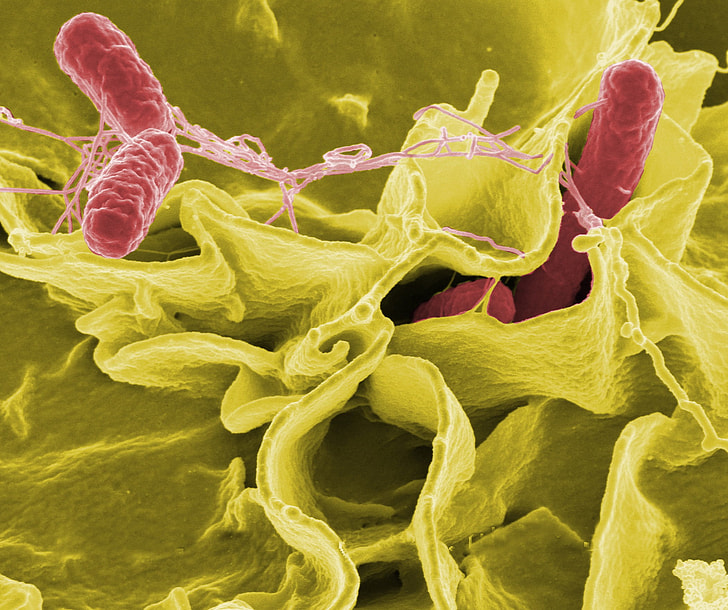
- Next in the intestines the bacteria use pili (finger like projections) or adhesions to attach to the intestinal lining.
- Some bacteria stay attached here where they can produce enterotoxins and survive, this often leads to sever diarrhoea.
- Other bacteria can invade the intestinal cells and move into the body where they can grow and cause disease. For example Salmonella enters macrophages (a type of immune cell) and spreads to other organs causing systemic infections (typhoid fever).
 Swimming with Sewage